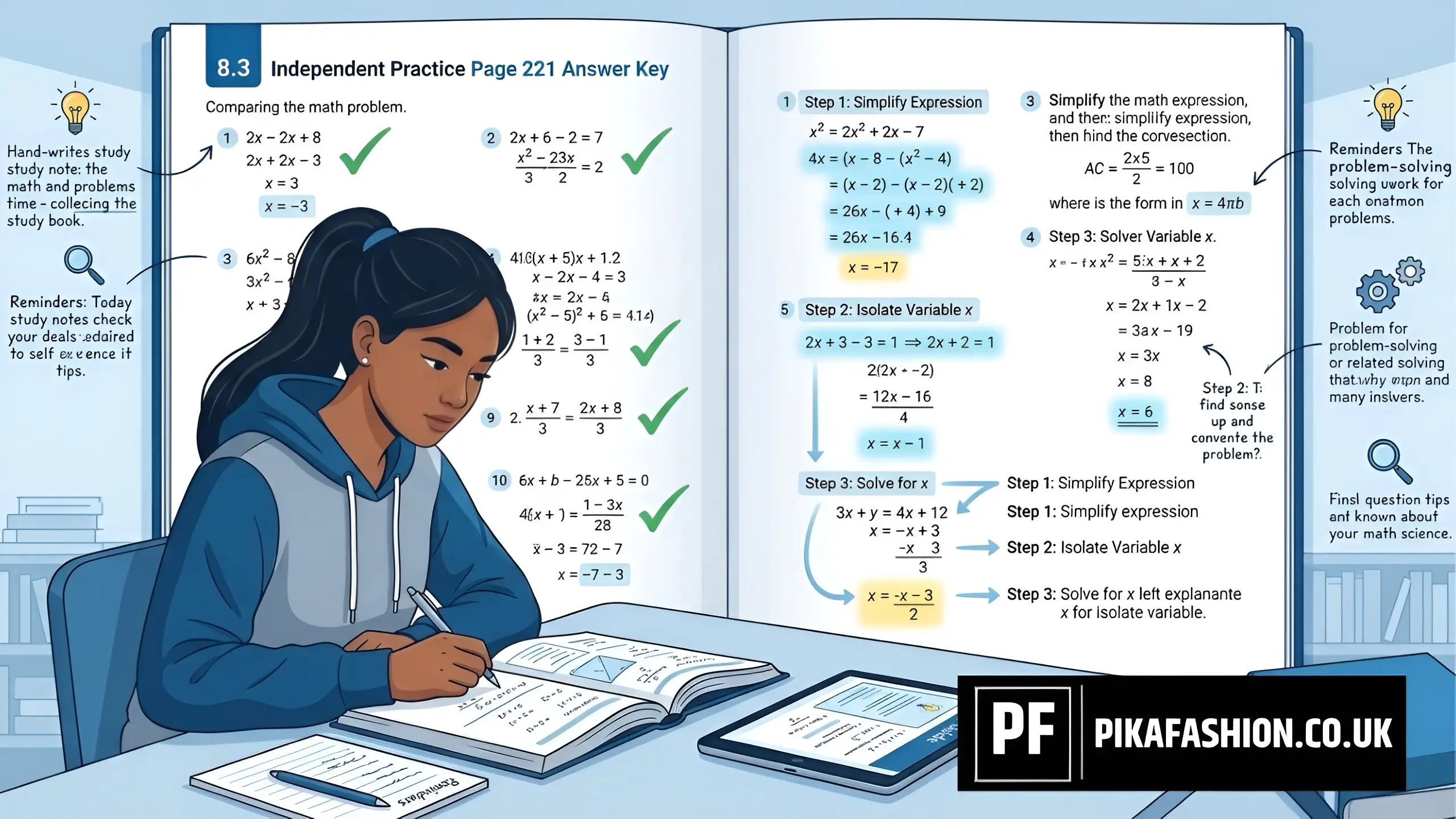
Navigating through independent practice sections requires more than just finding answers—it demands a thorough understanding of the underlying concepts and methodologies. The 8.3 independent practice page 221 answer key represents a critical learning checkpoint where students consolidate their mathematical knowledge and develop problem-solving competencies that extend far beyond mere memorization. This comprehensive guide explores not only what the answers are, but how to approach similar problems, understand the reasoning behind solutions, and build lasting academic confidence.
Understanding the Significance of Independent Practice Materials
Independent practice represents one of the most valuable phases of the learning process. When students encounter materials like page 221 in their textbooks or workbooks, they’re engaging with carefully structured problems designed to reinforce specific competencies. The 8.3 independent practice page 221 answer key serves as a validation tool, yet its true value lies in how students utilize it for deep learning rather than surface-level checking.
Independent practice problems are deliberately sequenced to progress from foundational concepts to more complex applications. This scaffolding approach ensures that students build confidence gradually while developing the critical thinking skills necessary for advanced coursework. When you access the 8.3 independent practice page 221 answer key, you’re not simply obtaining correct answers—you’re gaining insight into how experienced educators expect problems to be solved, how solutions should be presented, and what key concepts are non-negotiable for mastery.
The importance of independent practice cannot be overstated in contemporary education. Research consistently demonstrates that students who engage meaningfully with practice materials significantly outperform those who skip directly to answers or seek shortcuts. The 8.3 independent practice page 221 answer key becomes genuinely valuable only when integrated into a systematic study approach that emphasizes understanding over answer acquisition.
Strategies for Maximizing Learning from Practice Materials
Before consulting answer keys, successful students typically attempt problems independently. This struggle phase, while sometimes frustrating, activates critical cognitive processes that strengthen neural pathways and enhance retention. When you finally reference the 8.3 independent practice page 221 answer key, your brain is primed to recognize effective solution strategies and understand why certain approaches work better than others.
Effective Study Protocol for Independent Practice:
- Attempt all problems independently first—allocate sufficient time without consulting solutions
- Identify specific problems causing difficulty—note where your approach diverged from the answer key
- Study the answer key systematically—don’t just read solutions; analyze each step
- Rework problems using demonstrated techniques—recreate solutions without looking at the answer key
- Create summary notes—document key insights and common problem-solving patterns
- Practice similar problems—find additional resources with comparable difficulty levels
- Teach someone else—explaining concepts to peers solidifies understanding
This methodology transforms the 8.3 independent practice page 221 answer key from a passive reference into an active learning tool. Students who follow this protocol report higher confidence, better retention, and superior performance on assessments compared to those who simply match their answers to provided solutions.
Navigating Common Challenges in Problem-Solving
Many students struggle with specific types of problems on page 221 and similar practice sections. Understanding these common pitfalls helps you approach the 8.3 independent practice page 221 answer key more strategically and identify areas requiring additional focus.
Multi-Step Problem Solutions: Problems that require multiple operations often trip up students who rush through without planning. When examining the 8.3 independent practice page 221 answer key, notice how expert solutions typically begin with a clear problem setup. Before solving, identify what information you have, what you need to find, and what strategies might work. This preliminary analysis prevents careless errors and demonstrates sophisticated problem-solving thinking.
Conceptual Misunderstandings: Sometimes students arrive at incorrect answers despite using reasonable approaches. These situations reveal conceptual gaps rather than arithmetic errors. The 8.3 independent practice page 221 answer key becomes especially valuable here because it often shows alternative solution methods. Comparing different approaches helps you understand why one method succeeds while another fails, deepening your conceptual framework.
Application and Real-World Context: Many modern textbooks, including those containing page 221 materials, emphasize real-world applications. When using the 8.3 independent practice page 221 answer key, pay special attention to how concepts translate from abstract mathematics to practical situations. This connection strengthens transfer skills—your ability to apply knowledge in novel contexts.
Notation and Communication Standards: Different educational systems and textbooks sometimes employ varying notation and presentation conventions. The 8.3 independent practice page 221 answer key demonstrates the specific notation expected in your curriculum. Matching this presentation style ensures that your work will be recognized as correct, which matters significantly in educational assessments where partial credit often depends on showing work clearly.
Creating Your Personal Study System Around Practice Materials
Effective students develop personalized systems for working with materials like the 8.3 independent practice page 221 answer key. These systems reflect individual learning preferences while incorporating research-based best practices.
A robust study system begins with organized tracking. Maintain a document where you record problems from page 221 that you initially missed or found challenging. Note the specific reason for difficulty—was it a conceptual misunderstanding, a computational error, a misreading of the problem, or unfamiliar notation? This categorization helps you identify patterns in your learning needs.
Next, implement a spacing and interleaving protocol. Rather than completing all of page 221 in one session, distribute your practice across multiple days. Research demonstrates that spaced repetition dramatically enhances long-term retention compared to massed practice. Additionally, intersperse problems from page 221 with problems from other sections to promote better transfer. When students practice similar problems consecutively, they often develop superficial solutions that only work for identical setups. Interleaving forces deeper processing.
Your personalized system should also include self-assessment checkpoints. Before consulting the 8.3 independent practice page 221 answer key, honestly evaluate your confidence in your solution on a scale of one to five. Track this data over time. Initially, you might solve problems confidently that are actually incorrect—a dangerous combination. As you progress, your confidence assessments should increasingly match your actual accuracy, indicating improved metacognition.
Advanced Problem-Solving Techniques Found in Answer Keys
Professional problem-solvers use techniques that distinguish excellent solutions from adequate ones. The 8.3 independent practice page 221 answer key exemplifies these techniques, and recognizing them enhances your problem-solving repertoire.
Efficiency and Elegance: Notice how answer keys often take the most direct route to solutions. While multiple paths might lead to correct answers, experienced mathematicians recognize the most elegant approach. Study these efficient methods, but don’t assume they emerge obviously—elegant solutions often represent refined thinking developed through extensive practice.
Verification Strategies: Quality answer keys demonstrate how to verify solutions. Some problems allow you to substitute your answer back into the original equation. Others permit reasonableness checks—does your answer make logical sense given the problem context? Some solutions employ alternative methods to confirm results. These verification approaches protect against errors in high-stakes situations.
Pattern Recognition: As you progress through the 8.3 independent practice page 221 answer key, patterns emerge. Similar problem structures yield to similar strategies. Explicitly noting these patterns—perhaps by annotating your answer key with notes about approach categories—builds your intuitive problem-solving abilities. Over time, recognizing a problem’s structure immediately suggests appropriate strategies.
Supporting Different Learning Modalities
Students have diverse learning preferences, and the 8.3 independent practice page 221 answer key can be adapted for different modalities.
For visual learners, create graphic organizers summarizing the solution approaches on page 221. Draw diagrams, flow charts, or concept maps connecting different problem types to their solution strategies. Highlighting color-coded elements helps distinguish different components of solutions.
For auditory learners, verbally explain solutions aloud before consulting the 8.3 independent practice page 221 answer key. Then, articulate why your approach might have differed from the provided answer. Recording yourself explaining problem solutions creates a personal study resource for later review.
For kinesthetic learners, physically manipulate the problem-solving process. Use manipulatives, draw diagrams, or work through solutions using large-scale written work. The physical engagement of handwriting solutions often enhances retention compared to typing or passive reading of the 8.3 independent practice page 221 answer key.
Building Conceptual Bridges Across Topics
While the 8.3 independent practice page 221 answer key addresses specific problems, effective learners recognize connections to related concepts and earlier material. This integration creates stronger, more flexible knowledge structures.
Spend time reflecting on how concepts in section 8.3 connect to section 8.2. What foundational ideas from earlier chapters are being applied? How do these problems prepare you for subsequent material? This contextual awareness prevents mathematics from feeling like isolated problem types and instead reveals the interconnected structure of mathematical thinking.
When reviewing the 8.3 independent practice page 221 answer key, create relationship maps showing how different problem types connect. Some connections will be obvious—problems in the same section often share conceptual cores. Other connections are more subtle but equally important. A problem that appears unrelated to earlier material might utilize the same underlying principle in a different context.
FAQ Section: Essential Questions About Page 221 Answer Keys
Q: Should I always check my answers against the answer key immediately after completing a problem?
A: Not necessarily. For most learners, attempting to solve all problems independently first produces better outcomes than checking answers incrementally. The struggle phase activates deeper cognitive processing. Reserve answer key consultation for after you’ve completed a full section or honestly attempted everything possible.
Q: What should I do if my answer differs from the answer key but I believe my approach was correct?
A: This situation often indicates either a computational error on your part or an error in the answer key (rare but possible). Work through your solution again carefully, checking each arithmetic step. If you still believe your approach was valid, ask your instructor. Sometimes multiple solution paths legitimately exist, and your answer key might show only one.
Q: How can I use the answer key to improve my weak areas?
A: Categorize the problems you missed into groups by difficulty type. For each group, create a brief study sheet explaining the concept and demonstrating the solution method. Practice additional similar problems, ideally from other sources, to develop fluency. The answer key becomes most valuable when it informs targeted practice focused on genuine gaps.
Q: Is it cheating to look at the answer key while working on page 221?
A: Context matters. Looking at the answer key because you’re completely stuck wastes valuable struggle time but isn’t necessarily cheating. However, using the answer key to avoid genuine effort undermines learning. The ethical guideline is straightforward: use the answer key as a learning tool to understand material, not as a shortcut to complete assignments without thinking.
Q: How should I organize my notes when studying from an answer key?
A: Create a two-column format: your solution approach on the left, the answer key solution on the right. Annotate differences clearly. Add a “Key Insights” column noting what you learned from any discrepancies. This format makes it easy to review and identify patterns in your typical mistakes.
Q: Should I memorize all solutions from the answer key?
A: No. Memorization defeats the purpose of independent practice. Instead, understand the problem-solving process and key concepts. Your goal is to develop the ability to solve similar unfamiliar problems independently, not to memorize specific solutions.
Q: What if I have access to the answer key before attempting problems?
A: Resist the temptation to look. Cover the answer key while working. The advance knowledge that answers exist creates psychological pressure to look prematurely. Physical separation during the attempt phase strengthens your independent problem-solving muscles.
Q: How long should I spend attempting a problem before consulting the answer key?
A: This varies by problem complexity and your skill level. A reasonable guideline: if you’ve been stuck on the same problem for 15-20 minutes and have tried multiple approaches, consulting the answer key is reasonable. However, if you haven’t tried at least three different strategies, spend more time thinking independently.
Q: Can the answer key help me prepare for assessments?
A: Absolutely. However, recognize the distinction between looking at an answer key and solving practice problems independently. To prepare for assessments, solve problems similar to page 221 without consulting the answer key, then check your work. This simulation of test conditions develops the independence required during actual assessments.
Q: What should I do with the answer key after finishing page 221?
A: Keep it for future reference. When you encounter related problems in subsequent sections, reviewing page 221 solutions often provides helpful context. Additionally, if you’re reviewing material before a cumulative assessment, returning to page 221 answers provides efficient review.
Integrating Answer Keys into Comprehensive Study Plans
The 8.3 independent practice page 221 answer key works best as one component within a comprehensive study approach rather than as an isolated resource. Effective learners view the answer key as a tool supporting broader learning objectives.
Start by establishing clear learning goals for page 221 material. What specific competencies must you demonstrate? What types of problems will appear on assessments? Understanding these objectives helps you evaluate whether your answer key study is actually preparing you for what matters.
Next, establish a study timeline that distributes page 221 practice across several sessions rather than cramming everything into one sitting. This spacing effect produces dramatically better long-term retention. Schedule specific times for independent practice, answer key review, and rework sessions.
Create accountability mechanisms. Study partners can quiz each other on page 221 concepts without the answer key present. Teaching a classmate how to solve specific problems from page 221 deepens your understanding while identifying remaining weak areas. Explaining why a particular approach fails often clarifies concepts more effectively than reviewing why the correct approach succeeds.
Technology and Answer Key Resources
Modern students have access to diverse answer key resources beyond traditional textbooks. Online platforms, solution manuals, and video explanations supplement standard answer keys. However, integrating these resources requires care to maintain the learning benefits discussed throughout this guide.
Video solutions demonstrating page 221 problems can be exceptionally valuable for visual and kinesthetic learners. However, watching videos should supplement, not replace, personal problem-solving attempts. A robust approach involves attempting problems independently, then watching solution videos to understand alternative approaches or to clarify misunderstandings.
Online answer keys often include worked steps, which can be more instructive than brief answer statements. Pay particular attention to these step-by-step solutions, as they reveal problem-solving thinking that isn’t always apparent in standalone numerical answers.
Overcoming Common Answer Key Pitfalls
Despite their value, answer keys can be misused in ways that undermine learning. Awareness of these pitfalls helps you avoid them.
Answer Key Dependency: Students sometimes become so reliant on answer keys that they lose confidence in independent problem-solving. Counteract this by deliberately working problems without access to answers, increasing difficulty gradually as your confidence grows.
Superficial Checking: Quickly comparing your numerical answer to the answer key without understanding the solution method wastes the learning opportunity. Force yourself to engage deeply with every discrepancy.
Confirmation Bias: When your answer matches the answer key, students often assume correctness without verifying their reasoning. Occasionally work backward from the answer key answer, checking whether their approach would have yielded correct results.
Ignoring Notation Differences: Sometimes answer keys present solutions using slightly different notation or formatting than students use. Rather than viewing this as irrelevant, embrace the opportunity to become fluent in multiple representation systems.
Conclusion: Mastering Mathematics Through Thoughtful Answer Key Integration
The 8.3 independent practice page 221 answer key represents far more than a simple solutions list. When utilized thoughtfully, it becomes a powerful educational tool supporting deep learning, conceptual development, and problem-solving mastery. Success requires moving beyond passive answer checking to active engagement with solutions, understanding the reasoning behind each step, and deliberately practicing similar problems until concepts solidify.
Your journey with page 221 materials reflects your broader mathematical development. The strategies outlined in this comprehensive guide—attempting problems independently, studying answer keys systematically, identifying and addressing conceptual gaps, and distributing practice across multiple sessions—apply across all your mathematical studies. By developing these habits now, you’re building capabilities that will serve you throughout advanced coursework and professional applications.
Remember that the answer key is your study partner, not your shortcut. Approach it with respect for the educational process it supports, and you’ll find that mathematical confidence, competence, and genuine understanding develop naturally. Your commitment to understanding the material behind the 8.3 independent practice page 221 answer key demonstrates the serious approach to learning that characterizes successful students.
For More Visits: Pika Fashion
Also Read: Map 2.0 Post Assessment Answers: 5 Proven Strategies